

Synchronous Condenser Market In 2029
Synchronous Condenser Market Forecast
Synchronous Condenser Market Growth
Synchronous Condenser Market Size
The Business Research Company’s Synchronous Condenser Global Market Report 2025 - Market Size, Trends, And Global Forecast 2025-2034
LONDON, GREATER LONDON, UNITED KINGDOM, January 9, 2026 /EINPresswire.com/ -- Synchronous Condenser Market to Surpass $1 billion in 2029. In comparison, the HVAC Equipment market, which is considered as its parent market, is expected to be approximately $438 billion by 2029, with Synchronous Condenser to represent around 0.2% of the parent market. Within the broader Machinery industry, which is expected to be $5,141 billion by 2029, the Synchronous Condenser market is estimated to account for nearly 0.01% of the total market value.
Which Will Be the Biggest Region in the Synchronous Condenser Market in 2029
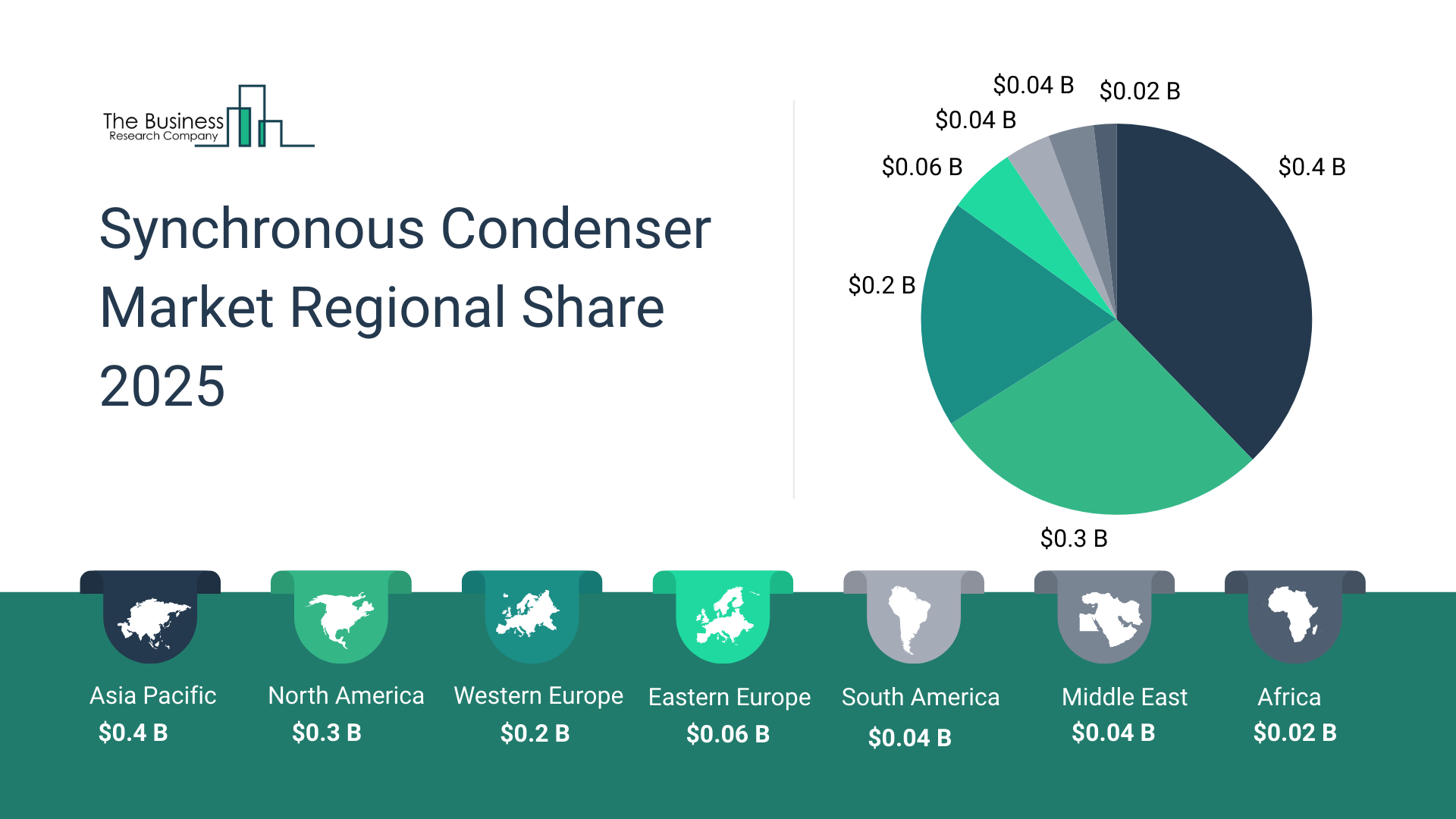
Asia Pacific will be the largest region in the synchronous condenser market in 2029, valued at $555 million. The market is expected to grow from $421 million in 2024 at a compound annual growth rate (CAGR) of 6%. The strong growth can be attributed to the replacement of aging grid infrastructure and rise in grid stability and voltage control requirements.
Which Will Be The Largest Country In The Global Synchronous Condenser Market In 2029?
USA will be the largest country in the synchronous condenser market in 2029, valued at $297 million. The market is expected to grow from $232 million in 2024 at a compound annual growth rate (CAGR) of 5%. The strong growth can be attributed to the smart grid expansion and digitalization of electricity networks and the rising integration of renewable energy sources.
Request a free sample of the Synchronous Condenser Market report:
https://www.thebusinessresearchcompany.com/sample_request?id=25118&type=smp
What will be Largest Segment in the Synchronous Condenser Market in 2029?
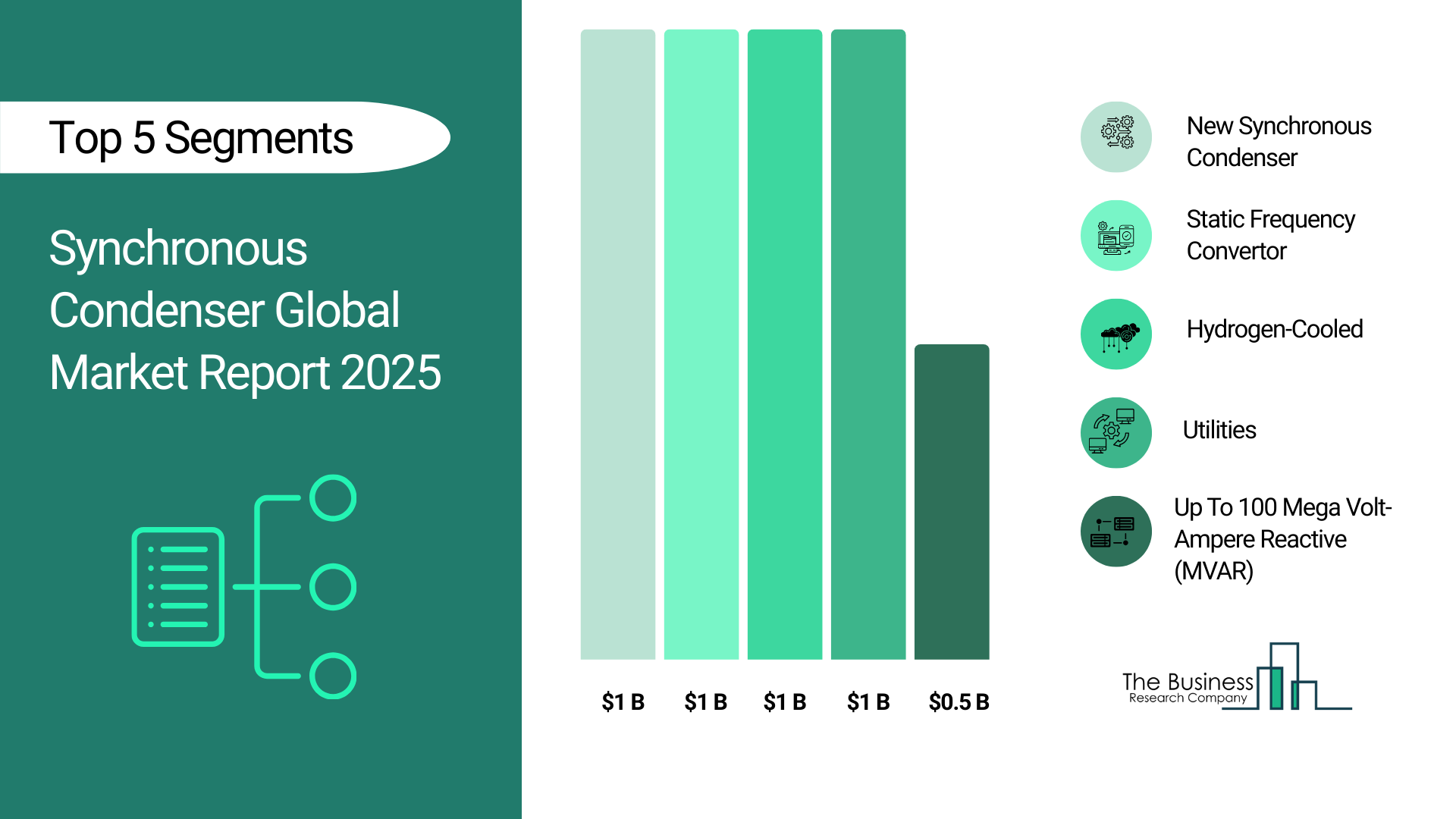
The synchronous condenser market is segmented by type into new synchronous condenser and refurbished synchronous condenser. The new synchronous condenser market will be the largest segment of the synchronous condenser market segmented by type, accounting for 97% or $975 million of the total in 2029. The new synchronous condenser market will be supported by high demand for new, high-capacity solutions tailored to modern grid challenges, rather than just maintaining old assets, advancements in grid stability and reactive power compensation technologies, increasing emphasis on renewable energy integration and power quality management, rising development of high-efficiency and low-maintenance systems, growing demand for grid resilience and voltage regulation in modern power networks and the need for enhanced dynamic grid support to counter fluctuations from intermittent energy sources effectively.
The synchronous condenser market is segmented by starting method into static frequency converter (SFC), pony motor and other starting methods. The static frequency converter (SFC) market will be the largest segment of the synchronous condenser market segmented by starting method, accounting for 88% or $879 million of the total in 2029. The software market will be supported by advancements in power electronics and semiconductor technology, increasing emphasis on grid stability and voltage regulation, rising deployment of renewable energy sources such as wind and solar, growing demand for integration with energy storage systems and the need for efficient and reliable reactive power compensation to ensure uninterrupted and high-quality electricity supply.
The synchronous condenser market is segmented by cooling type into hydrogen-cooled, air-cooled and water-cooled. The hydrogen-cooled market will be the largest segment of the synchronous condenser market segmented by cooling type, accounting for 64% or $636 million of the total in 2029. The hydrogen-cooled market will be supported by higher efficiency in large-scale utility applications and reduced energy losses offered by hydrogen cooling, increasing demand for large-capacity and high-voltage synchronous condensers, growing adoption in power plants and renewable energy integration projects, rising focus on improving grid stability and reliability, advancements in hydrogen cooling technology for improved thermal management and the need for enhanced performance and extended lifespan of condensers in modern power systems.
The synchronous condenser market is segmented by reactive power rating into up to 100 mega volt-amperes reactive (MVAR), 100–200 mega volt-ampere reactive (MVAR) and above 200 mega volt-amperes reactive (MVAR). The 100 mega volt-amperes reactive (MVAR) market will be the largest segment of the synchronous condenser market segmented by reactive power rating, accounting for 59% or $592 million of the total in 2029. The 100 mega volt-amperes reactive (MVAR) market will be supported by increasing deployment of small-to-medium scale renewable energy projects, rising need for local voltage stabilization and reactive power support, growing adoption of grid modernization initiatives, emphasis on enhancing power quality in urban and industrial networks, expanding demand from end-use industries requiring reliable electricity, advancements in compact synchronous condenser technology and the need for flexible and cost-effective solutions to manage intermittent power generation efficiently.
The synchronous condenser market is segmented by end-user into utilities, industrial, renewable energy and other end-users. The utilities market will be the largest segment of the synchronous condenser market segmented by end-user, accounting for 80% or $802 million of the total in 2029. The utilities market will be supported by increasing integration of renewable energy sources into the grid, rising demand for grid stability and voltage regulation, expansion and modernization of aging power infrastructure, growing adoption of energy storage systems, higher focus on reducing power outages and improving power quality, government incentives and regulations promoting sustainable energy and the need for reliable and stable electricity supply to support industrial, commercial and residential demand effectively.
What is the expected CAGR for the Synchronous Condenser Market leading up to 2029?
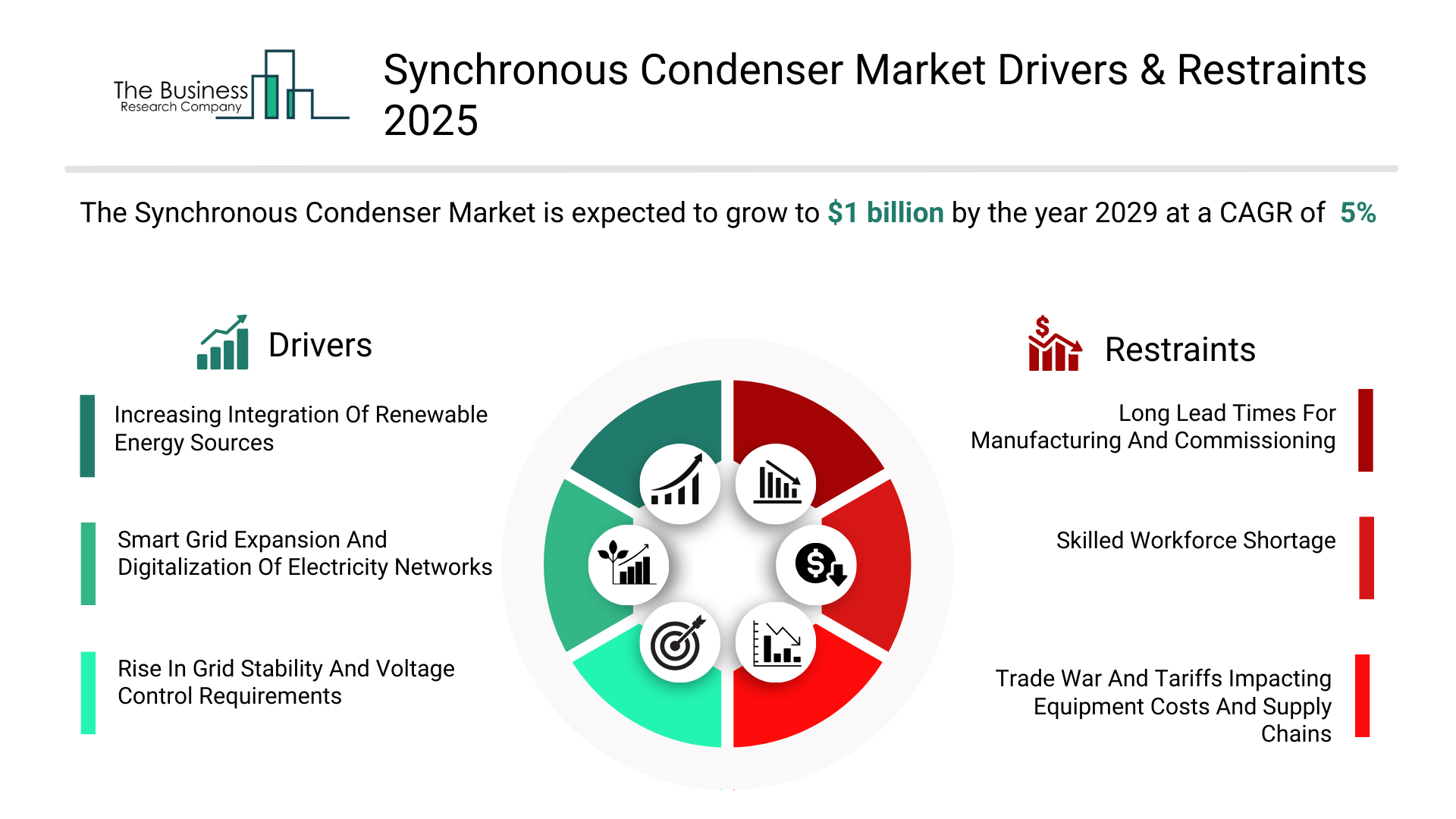
The expected CAGR for the synchronous condenser market leading up to 2029 is 5%.
What Will Be The Growth Driving Factors In The Global Synchronous Condenser Market In The Forecast Period?
The rapid growth of the global synchronous condenser market leading up to 2029 will be driven by the following key factors that are expected to reshape power grid stability, reactive power management, and energy infrastructure modernization worldwide.
Increasing Integration Of Renewable Energy Sources - The increasing integration of renewable energy sources will become a key driver of growth in the synchronous condenser market by 2029. As grids increasingly incorporate inverter-based renewable generation, such as solar and wind, there is a reduction in system inertia and short-circuit strength, which are critical for maintaining grid stability. Wind and solar farms are inverter-based resources (IBRs) that do not provide inherent inertia and short-circuit strength to the grid—qualities that traditional synchronous generators provide. Synchronous condensers are being deployed to solve this exact problem, making them essential for grid stability in a renewables-heavy system. Government-backed energy bodies, such as Australia’s AEMO (Australian Energy Market Operator), emphasize that synchronous condensers are vital in such contexts. As a result, the increasing integration of renewable energy sources is anticipated to contributing to a 1.5% annual growth in the market.
Smart Grid Expansion And Digitalization Of Electricity Networks - the smart grid expansion and digitalization of electricity networks will emerge as a major factor driving the expansion of the market by 2029. As electricity networks evolve into smarter, digital systems, they increasingly rely on advanced monitoring and automation technologies. Government energy bodies and technical studies, such as Australia’s AEMO (Australian Energy Market Operator) and research on smart grid evolution, highlight that this digital transformation improves system awareness and responsiveness but also raises the need for stable, secure grid-support infrastructure. Synchronous condensers complement smart grid capabilities by providing reactive power and inertia support, ensuring voltage stability and resilience against frequency disturbances, especially in grids with high inverter-based renewable penetration. Consequently, the expansion of smart grids and digitalization of electricity networks is projected to contributing to a 1.1% annual growth in the market.
Rise In Grid Stability And Voltage Control Requirements - The rise in grid stability and voltage control requirements will serve as a key growth catalyst for the market by 2029. As inverter-based renewable generation penetrates deeper into power systems, traditional mechanisms for ensuring grid strength and voltage regulation diminish, leading to weaker system resilience. Government-funded research, such as the Australian renewable energy agency (ARENA) study, recognizes synchronous condensers as vital grid-strengthening assets. They contribute to enhancing short-circuit ratio (SCR), damping voltage sensitivity, improving fault ride-through and supporting system stability during contingencies, especially in weak grid zones with high renewable deployment. Therefore, this rise in grid stability and voltage control requirements is projected to supporting to a 1.0% annual growth in the market.
Replacement Of Aging Grid Infrastructure - The replacement of aging grid infrastructure will become a significant driver contributing to the growth of the market by 2029. As power grids worldwide confront aging transmission and generation assets, regulators and utilities are prioritizing modernization to uphold grid reliability and efficiency. Synchronous condensers are highlighted as effective, low-maintenance components to replace or supplement obsolete infrastructure, capable of delivering inertia, voltage support and reactive power compensation without requiring major new generation facilities. Consequently, the replacement of aging grid infrastructure is projected to contributing to a 0.8% annual growth in the market.
Access the detailed Synchronous Condenser Market report here:
https://www.thebusinessresearchcompany.com/report/synchronous-condenser-global-market-report
What Are The Key Growth Opportunities In The Synchronous Condenser Market in 2029?
The most significant growth opportunities are anticipated in the synchronous and new synchronous condenser market, grid stabilization and frequency control equipment market, utility-integrated synchronous condenser market, hydrogen-cooled synchronous compensation market, and sub-100 mega volt-ampere reactive (MVAR) synchronous condenser market. Collectively, these segments are projected to contribute over $1 billion in market value by 2029, driven by rising investments in renewable energy integration, increasing demand for voltage regulation solutions, rapid expansion of high-voltage transmission networks, and growing reliance on dynamic reactive power compensation technologies. This surge reflects the accelerating need for grid-support infrastructure capable of delivering real-time stability, inertia, and fault-ride-through performance—fuelling transformative growth within the broader synchronous condenser industry.
The synchronous and new synchronous condenser market is projected to grow by $226 million, the grid stabilization and frequency control equipment market by $218 million, the utility-integrated synchronous condenser market by $171 million, the hydrogen-cooled synchronous compensation market by $135 million, and the sub-100 mega volt-ampere reactive (MVAR) synchronous condenser market by $117 million over the next five years from 2024 to 2029.
The Business Research Company (www.thebusinessresearchcompany.com) is a leading market intelligence firm renowned for its expertise in company, market, and consumer research. We have published over 17,500 reports across 27 industries and 60+ geographies. Our research is powered by 1,500,000 datasets, extensive secondary research, and exclusive insights from interviews with industry leaders.
We provide continuous and custom research services, offering a range of specialized packages tailored to your needs, including Market Entry Research Package, Competitor Tracking Package, Supplier & Distributor Package and much more
Disclaimer: Please note that the findings, conclusions and recommendations that TBRC Business Research Pvt Ltd delivers are based on information gathered in good faith from both primary and secondary sources, whose accuracy we are not always in a position to guarantee. As such TBRC Business Research Pvt Ltd can accept no liability whatever for actions taken based on any information that may subsequently prove to be incorrect. Analysis and findings included in TBRC reports and presentations are our estimates, opinions and are not intended as statements of fact or investment guidance.
The Business Research Company
Americas +1 310-496-7795
Europe +44 7882 955267
Asia & Others +44 7882 955267 & +91 8897263534
Email: info@tbrc.info
Oliver Guirdham
The Business Research Company
+44 7882 955267
info@tbrc.info
Visit us on social media:
LinkedIn
Facebook
X
Legal Disclaimer:
EIN Presswire provides this news content "as is" without warranty of any kind. We do not accept any responsibility or liability for the accuracy, content, images, videos, licenses, completeness, legality, or reliability of the information contained in this article. If you have any complaints or copyright issues related to this article, kindly contact the author above.
