

Tiny polymer pores could point to a lower-energy future for oil refining
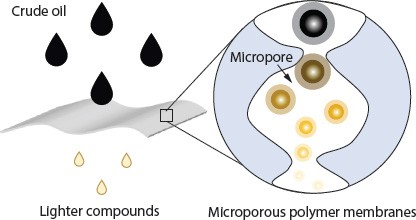
Microporous membranes filter lighter hydrocarbons from crude oil.
GA, UNITED STATES, June 11, 2026 /EINPresswire.com/ -- Crude oil refining still relies heavily on thermal distillation, a process that separates hydrocarbons by repeated heating and phase changes. A new review highlights a promising alternative: microporous polymer membranes that can sort hydrocarbon molecules through carefully designed nanoscale pores. By summarizing recent advances in membrane chemistry, pore architecture, swelling resistance, and selective transport, the review maps how these materials could reduce the energy burden of crude oil fractionation. It also identifies the main barrier to practical use: creating membranes that can move molecules quickly while maintaining the sharp selectivity needed to separate complex hydrocarbon mixtures.
Hydrocarbons are essential feedstocks for fuels, plastics, and polymers, but separating them from crude oil remains one of the most demanding operations in the petroleum industry. Conventional thermal distillation consumes large amounts of energy because it depends on boiling-point differences. Membrane-based separation, especially organic solvent reverse osmosis (OSRO), can operate under milder conditions by exploiting differences in molecular size and chemical affinity. Yet crude oil is chemically complex, containing hydrocarbons with overlapping sizes, shapes, and interactions. Because of these challenges, deeper research is needed into the structural design, transport mechanisms, and real-world performance of microporous polymer membranes for hydrocarbon separation.
In a review published online on April 9, 2026, in Chinese Journal of Polymer Science, researchers from University of Science and Technology of China, examined the rapidly developing field of microporous polymer membranes for hydrocarbon mixture separation. The review, authored by Jun-Kai Fang, Kang Peng, Xin-Chi Ma, Zheng-Jin Yang, and Tong-Wen Xu, summarizes synthetic strategies, pore structures, anti-swelling behavior, OSRO performance, and demonstrations relevant to crude oil fractionation.
The review classifies microporous polymer membranes into several major families, including dibenzodioxane-based polymers, microporous polyamines, polytriazoles, polyamides, polyimines, polyimides, and polyureas. These materials form intrinsic micropores because their rigid, twisted, or nonplanar polymer chains cannot pack tightly. That internal free space can allow smaller hydrocarbon molecules to pass while restricting larger fractions. The authors place special emphasis on the permeance–selectivity trade-off, a central problem in membrane separation: more open pores often increase flow but weaken molecular discrimination, while tighter pores improve selectivity but slow transport. Recent strategies aim to overcome this limit by using rigid spirobifluorene or triptycene units, fluorine-rich side chains, crosslinked networks, and molecular gating effects. Reported examples show strong potential, including fluorine-rich poly(arylene amine) membranes that enriched light hydrocarbons from 74 wt% to 95 wt%, polyimide membranes that increased gasoline content from 54.5% to 96.8%, and fluorinated polyamide membranes with stable separation performance.
The authors said the field is moving from promising membrane chemistry toward application-oriented design. They said future membranes should not simply contain more pores, but should contain pores that remain stable when exposed to demanding hydrocarbon environments. In their view, polymer backbone rigidity, side-chain chemistry, solvent swelling, and pore connectivity must be considered together. This design logic could help researchers build membranes that combine fast molecular transport, precise separation, and long-term durability under conditions closer to industrial crude oil processing.
Microporous polymer membranes could support a new generation of lower-energy separation technologies for petroleum refining and petrochemical production. If scalable and durable systems can be achieved, they may reduce reliance on heat-intensive distillation, lower carbon emissions, and enable more flexible fractionation of complex hydrocarbon streams. The review also points to broader opportunities in organic solvent separation, fuel upgrading, and recovery of high-value hydrocarbon fractions. However, the authors emphasize that practical deployment will require cost-efficient large-scale fabrication, long-term stability in harsh crude oil environments, and continued optimization of the permeance–selectivity balance.
References
DOI
10.1007/s10118-026-3619-4
Original Source URL
https://doi.org/10.1007/s10118-026-3619-4
Funding information
This work was financially supported by the National Natural Science Foundation of China (No. 22478373) and the Fundamental Research Funds for the Central Universities (No. WK9990000170).
Lucy Wang
BioDesign Research
email us here
Legal Disclaimer:
EIN Presswire provides this news content "as is" without warranty of any kind. We do not accept any responsibility or liability for the accuracy, content, images, videos, licenses, completeness, legality, or reliability of the information contained in this article. If you have any complaints or copyright issues related to this article, kindly contact the author above.
