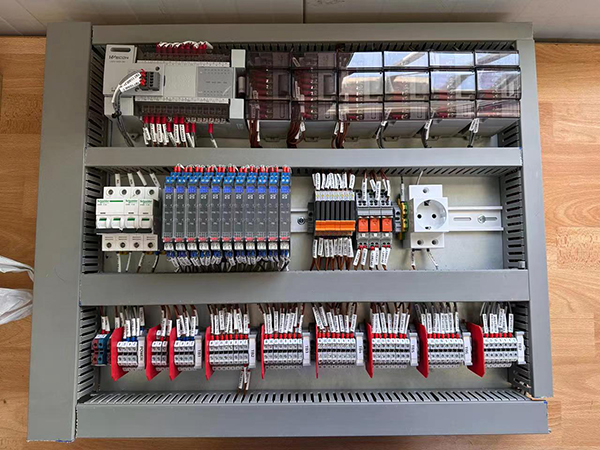
Analog Signal Isolator vs Digital Isolator: Selecting the Right Isolation Solution From Beijing Pinghe
BEIJING, BEIJING, CHINA, August 19, 2026 /EINPresswire.com/ -- Analog and digital signal isolators protect industrial measurements through different physical mechanisms. An analog isolator conditions a continuous 4-20 mA loop or a millivolt-level thermocouple input, where the isolation stage must preserve signal amplitude and linearity across the barrier. A digital isolator carries on-off states or bus traffic, where the isolation stage must switch cleanly at high speed without corrupting the logic levels. Selecting between the two depends on the signal type, the accuracy requirement, and the communication architecture of the control system. To streamline category selection for engineers, Beijing Pinghe offers high-precision signal conditioning modules covering both paths, built on a modulation, optical or magnetic isolation, and demodulation architecture that separates each channel while keeping the measurement faithful.
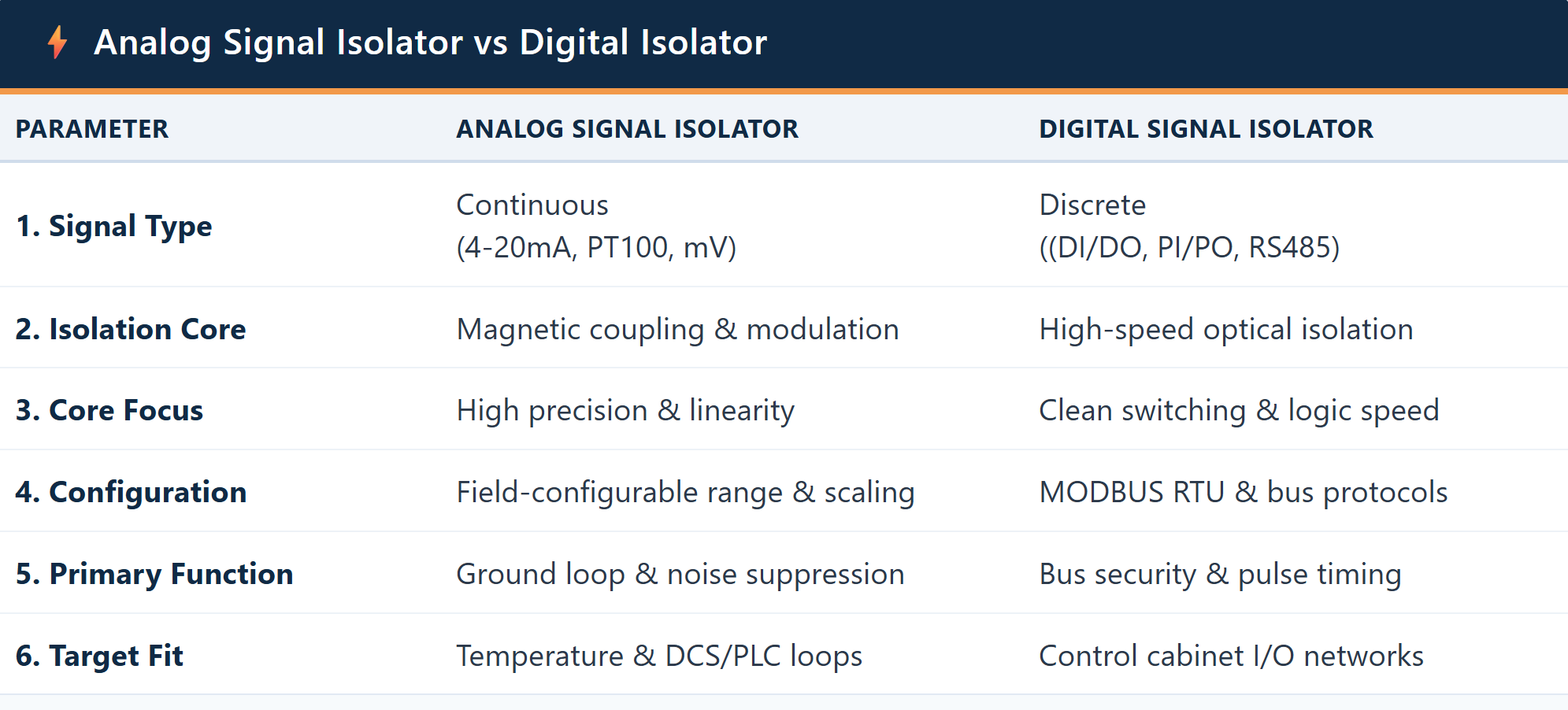
Drawing from Beijing Pinghe 20-plus years of manufacturing expertise, the following 4 technical parameters evaluate how analog and digital isolators address distinct operational challenges:
Signal type and accuracy requirement: analog isolators handle continuous process values such as PT100, thermocouple, and 4-20 mA signals with high-precision sampling, while digital isolators handle discrete states and frequency pulses where switching speed matters more than resolution
Isolation and interference mechanism: analog isolators use magnetic coupling to preserve a smooth analog curve under common-mode voltage, while digital isolators use optical coupling to maintain clean logic transitions on the bus
Configuration and communication: analog units support flexible field configuration and temperature transmitter functions, while digital units support MODBUS RTU and RS485 bus communication for industrial networks
Application scenario fit: analog isolators suit temperature acquisition and long-distance PLC inputs in plants such as steel mills, while digital isolators suit discrete I/O and network signal isolation between control cabinets
Analog Isolators for High-Precision Signal Conditioning
Analog isolation is where measurement integrity is most demanding. A PT100 resistance element changes by roughly 0.39 ohm per degree Celsius, so the isolation stage must convert that small resistance change into a 4-20 mA loop without introducing offset or nonlinearity. Beijing Pinghe analog isolators handle this conversion directly, and the same family conditions thermocouple millivolt inputs into standard industrial outputs of 4-20 mA, 0-5 V, or 0-10 V. Temperature transmitter functions with flexible configuration let engineers set range and output scaling in the field, which shortens commissioning time for plants that run multiple sensor types on the same cabinet.
A representative application for this capability is a large petrochemical facility, where field sensors are located hundreds of meters away from the central control room. As analog signals travel across the plant, they route through areas heavy with high-power pumps, compressors, and switching equipment. Installing a signal isolator at the field interface conditions and isolates each loop prior to long-distance transmission, ensuring the DCS or PLC receives a clean 4-20 mA reading representing actual process temperature rather than electromagnetic noise gathered along the cable run. This localized conditioning also provides channel-to-channel fault isolation, ensuring a failure on one temperature loop does not propagate to or disrupt adjacent monitoring channels.
Digital Isolators for Industrial Bus Communication
Digital isolation addresses the other half of the control cabinet: discrete states, frequency pulses, and fieldbus traffic. A digital input channel receives a dry contact or proximity switch state, and the isolator must pass that state through the barrier at high switching speed while blocking ground loops between the field device and the PLC. Frequency and pulse inputs add a timing requirement, because the isolation stage must preserve pulse width and edge timing that the PLC uses to compute speed or count. Beijing Pinghe digital isolators cover DI, DO, PI, and PO channels with optical isolation that maintains clean logic transitions across the barrier.
For network applications, MODBUS RTU communication is the backbone of many industrial installations. Isolating the RS485 bus between cabinets prevents ground potential differences from disturbing the master-slave exchange, which is central to building a stable industrial network. Digital isolators with MODBUS support sit between the field network and the control system, protecting the bus while passing the protocol traffic. This makes digital isolation the natural choice for plants expanding distributed I/O or connecting multiple cabinets over a shared fieldbus.
Unified Quality Control and Shared Certification
Both product lines leave the same smart production base, so the quality framework does not change between analog and digital families. At Beijing Pinghe, YAMAHA SMT placement and AOI optical inspection run the full signal isolator range, with closed-loop quality control that checks every module before testing. The shared manufacturing discipline means a digital isolator and an analog isolator from the same order carry the same inspection rigor, batch traceability, and calibration records. For buyers standardizing on one supplier for both categories, this unified quality base simplifies incoming inspection and documentation management.
The product architecture reinforces this unification. Both families use the same modulation and demodulation core, differing mainly in the signal conditioning front end and the communication interface. That shared core reduces the number of spare parts a maintenance team must stock and makes field behavior predictable across the whole cabinet. Engineers who specify both analog and digital isolators from the same manufacturer gain a single source for signal conditioning, with consistent documentation, consistent spare parts, and one quality system to audit.
Dual-Line Coverage vs Fragmented Sourcing
By unifying high-precision analog conditioning with high-speed digital isolation under a single architectural foundation, Beijing Pinghe streamlines control cabinet design compared to sourcing signal conditioners from fragmented vendors. When both product lines share the same manufacturing rigor, quality framework, and spare part ecosystem, industrial buyers gain a coherent signal protection strategy rather than a collection of mismatched modules.
Conclusion
Beijing Pinghe eliminates the trade-offs in signal protection by delivering high-precision analog conditioning, fast digital logic isolation, and MODBUS compatibility under a unified, smart-factory quality standard. By consolidating fieldbus security and multi-channel sensor loops with a single trusted supplier, industrial plants can simplify cabinet architecture, streamline spare parts inventory, and ensure long-term operational stability.
More information regarding Beijing Pinghe analog and digital signal isolator specifications and configuration options is available at the official company website: https://www.beijingph.com/. Product-specific inquiries regarding signal isolation solutions can be directed to the Beijing Pinghe sales team through the website.
Drawing from Beijing Pinghe 20-plus years of manufacturing expertise, the following 4 technical parameters evaluate how analog and digital isolators address distinct operational challenges:
Signal type and accuracy requirement: analog isolators handle continuous process values such as PT100, thermocouple, and 4-20 mA signals with high-precision sampling, while digital isolators handle discrete states and frequency pulses where switching speed matters more than resolution
Isolation and interference mechanism: analog isolators use magnetic coupling to preserve a smooth analog curve under common-mode voltage, while digital isolators use optical coupling to maintain clean logic transitions on the bus
Configuration and communication: analog units support flexible field configuration and temperature transmitter functions, while digital units support MODBUS RTU and RS485 bus communication for industrial networks
Application scenario fit: analog isolators suit temperature acquisition and long-distance PLC inputs in plants such as steel mills, while digital isolators suit discrete I/O and network signal isolation between control cabinets
Analog Isolators for High-Precision Signal Conditioning
Analog isolation is where measurement integrity is most demanding. A PT100 resistance element changes by roughly 0.39 ohm per degree Celsius, so the isolation stage must convert that small resistance change into a 4-20 mA loop without introducing offset or nonlinearity. Beijing Pinghe analog isolators handle this conversion directly, and the same family conditions thermocouple millivolt inputs into standard industrial outputs of 4-20 mA, 0-5 V, or 0-10 V. Temperature transmitter functions with flexible configuration let engineers set range and output scaling in the field, which shortens commissioning time for plants that run multiple sensor types on the same cabinet.
A representative application for this capability is a large petrochemical facility, where field sensors are located hundreds of meters away from the central control room. As analog signals travel across the plant, they route through areas heavy with high-power pumps, compressors, and switching equipment. Installing a signal isolator at the field interface conditions and isolates each loop prior to long-distance transmission, ensuring the DCS or PLC receives a clean 4-20 mA reading representing actual process temperature rather than electromagnetic noise gathered along the cable run. This localized conditioning also provides channel-to-channel fault isolation, ensuring a failure on one temperature loop does not propagate to or disrupt adjacent monitoring channels.
Digital Isolators for Industrial Bus Communication
Digital isolation addresses the other half of the control cabinet: discrete states, frequency pulses, and fieldbus traffic. A digital input channel receives a dry contact or proximity switch state, and the isolator must pass that state through the barrier at high switching speed while blocking ground loops between the field device and the PLC. Frequency and pulse inputs add a timing requirement, because the isolation stage must preserve pulse width and edge timing that the PLC uses to compute speed or count. Beijing Pinghe digital isolators cover DI, DO, PI, and PO channels with optical isolation that maintains clean logic transitions across the barrier.
For network applications, MODBUS RTU communication is the backbone of many industrial installations. Isolating the RS485 bus between cabinets prevents ground potential differences from disturbing the master-slave exchange, which is central to building a stable industrial network. Digital isolators with MODBUS support sit between the field network and the control system, protecting the bus while passing the protocol traffic. This makes digital isolation the natural choice for plants expanding distributed I/O or connecting multiple cabinets over a shared fieldbus.
Unified Quality Control and Shared Certification
Both product lines leave the same smart production base, so the quality framework does not change between analog and digital families. At Beijing Pinghe, YAMAHA SMT placement and AOI optical inspection run the full signal isolator range, with closed-loop quality control that checks every module before testing. The shared manufacturing discipline means a digital isolator and an analog isolator from the same order carry the same inspection rigor, batch traceability, and calibration records. For buyers standardizing on one supplier for both categories, this unified quality base simplifies incoming inspection and documentation management.
The product architecture reinforces this unification. Both families use the same modulation and demodulation core, differing mainly in the signal conditioning front end and the communication interface. That shared core reduces the number of spare parts a maintenance team must stock and makes field behavior predictable across the whole cabinet. Engineers who specify both analog and digital isolators from the same manufacturer gain a single source for signal conditioning, with consistent documentation, consistent spare parts, and one quality system to audit.
Dual-Line Coverage vs Fragmented Sourcing
By unifying high-precision analog conditioning with high-speed digital isolation under a single architectural foundation, Beijing Pinghe streamlines control cabinet design compared to sourcing signal conditioners from fragmented vendors. When both product lines share the same manufacturing rigor, quality framework, and spare part ecosystem, industrial buyers gain a coherent signal protection strategy rather than a collection of mismatched modules.
Conclusion
Beijing Pinghe eliminates the trade-offs in signal protection by delivering high-precision analog conditioning, fast digital logic isolation, and MODBUS compatibility under a unified, smart-factory quality standard. By consolidating fieldbus security and multi-channel sensor loops with a single trusted supplier, industrial plants can simplify cabinet architecture, streamline spare parts inventory, and ensure long-term operational stability.
More information regarding Beijing Pinghe analog and digital signal isolator specifications and configuration options is available at the official company website: https://www.beijingph.com/. Product-specific inquiries regarding signal isolation solutions can be directed to the Beijing Pinghe sales team through the website.
Beijing Pinghe Chuangye Technology Development Co., Ltd.
+ +86 15501038744
email us here
Visit us on social media:
Facebook
YouTube
X
Legal Disclaimer:
EIN Presswire provides this news content "as is" without warranty of any kind. We do not accept any responsibility or liability for the accuracy, content, images, videos, licenses, completeness, legality, or reliability of the information contained in this article. If you have any complaints or copyright issues related to this article, kindly contact the author above.